

Can an Elevation Certificate Lower Flood Insurance Costs?
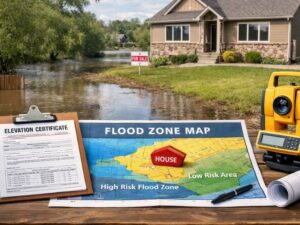
What an Elevation Certificate Actually Does
An elevation certificate is a form. A licensed land surveyor completes it. It records the exact elevation of a structure relative to the Base Flood Elevation (BFE) for that property.
The BFE is the flood height FEMA uses to set flood risk. If your building sits above the BFE, your risk drops. If it sits below, your risk goes up.
That relationship between your finished floor elevation and the BFE is what drives your National Flood Insurance Program (NFIP) premium. The certificate gives your insurer the data to calculate it.
When It Lowers Your Premium
Yes, it can lower costs. But only under specific conditions.
If your property sits in a Special Flood Hazard Area (SFHA), and your lowest floor is at or above the BFE, you will likely see a lower premium than the default rate. The difference can be significant. FEMA data shows that each foot above the BFE can reduce premiums by 10% to 25%, depending on the flood zone and structure type.
For a property in Herriman that might otherwise pay $1,500 to $3,000 per year in flood insurance, that math adds up quickly across a development portfolio.
Private flood insurers also use elevation data. Many base their pricing directly on the vertical difference between the building and the BFE. A well-documented certificate makes underwriting faster and often cheaper.
When It Does Not Help
Not every property benefits.
If the structure sits below the BFE, the certificate confirms elevated risk. That can actually raise your premium over the default estimate the insurer was using. Some developers discover their exposure is worse than expected once real survey data replaces the estimated rate.
Also, if the property is not in a mapped flood zone, the certificate may not affect pricing at all. In Herriman, many areas sit in Flood Zone X, which carries minimal flood risk. For those parcels, flood insurance is optional, and if purchased, it’s typically already low-cost.
The Herriman Context
Herriman is in Salt Lake County, near the Oquirrh Mountains. Most of the city sits in Zone X or shaded Zone X on FEMA Flood Insurance Rate Maps (FIRMs). These zones indicate reduced or moderate flood risk.
That said, there are parcels near drainage corridors and mountain runoff paths that carry higher zone designations. For those, the elevation certificate is especially worth getting before you close or break ground.
FEMA’s online Map Service Center (msc.fema.gov) lets you pull the current FIRM for any Herriman address. That’s the starting point before ordering a survey
What Developers Should Do Before Ordering One
Before you commission an elevation certificate, do three things:
Check the flood zone on the FIRM. If the parcel is Zone X with no flood map revision pending, you may not need one at all.
Confirm your lender’s requirements. Federally backed loans on properties in SFHAs require flood insurance, and lenders typically require an elevation certificate to document compliance.
Talk to your surveyor about timing. The certificate should be completed after construction reaches the lowest floor elevation. Getting it too early means ordering it again later, at added cost.
How It Fits Into Risk Pricing for a Portfolio
Developers managing multiple parcels should treat elevation certificates as a data layer, not just a compliance box.
If you’re building in mixed-zone areas, the certificates give you actual vertical data on each structure. That data feeds directly into insurance placement decisions. Some parcels may qualify for private flood coverage at better rates than NFIP. Some may justify a Letter of Map Amendment (LOMA), which removes a property from the SFHA designation entirely.
A LOMA, if approved by FEMA, eliminates the mandatory flood insurance requirement. It starts with a licensed surveyor completing and submitting the elevation documentation.
Frequently Asked Questions
Does every property in Herriman, Utah need an elevation certificate?
No. Properties in Zone X, which covers most of Herriman, don’t require one unless a lender specifically asks for it. It’s mainly required for structures in SFHAs when a federally backed mortgage is involved.
Who is qualified to complete an elevation certificate in Utah?
Only a licensed land surveyor, licensed engineer, or licensed architect may complete an NFIP elevation certificate in Utah. The surveyor must be licensed in the state of Utah.
How much does an elevation certificate cost in the Herriman area?
Fees vary by surveyor and site complexity. In the greater Salt Lake area, expect to pay between $400 and $800 for a standard residential or small commercial site.
Can the certificate be used for private flood insurance, not just NFIP?
Yes. Most private flood insurers accept the FEMA elevation certificate as part of their underwriting review. Some require additional site data, but the certificate is usually the starting point.
What’s the difference between an elevation certificate and a Letter of Map Amendment (LOMA)?
The elevation certificate documents a structure’s elevation. A LOMA is a formal request to FEMA to remove a property from the SFHA designation. The elevation certificate is often the supporting evidence for a LOMA application.